
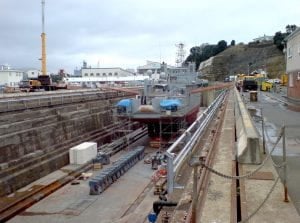
 Many an author is grateful for their world experiences, whether through career or travel. When I was at university I landed a rather unusual job working with a crew who ran the dry dock at Devonport, across the harbour from Auckland, New Zealand’s largest city. My job was to help work the pumps, grease the gears and help shore up the boats as they settled on the floor of the dry dock as the water was pumped out. I was about nineteen years of age at the time and never thought I would be able to use the experience in a novel. One day, while working on a chapter in my latest thriller, I realised how valuable my time in the dry dock was. It helped bring a chapter to life and give it authenticity—a measure of detail that few people would have.
I guess that writing is the sum of experience and observation? I am forever grateful for this part  time, and very humble, work in the naval dockyard. The crew I worked with gave me rich memories that came back to life when I was struggling for ideas for my latest novel. All experience, whether a struggle or triumph, does count. It acts like building blocks for your mind, allowing original and creative writing to flow.
 3 WISE MEN features real locations, real cafes, and real hotels , etc. in order to give authenticity to the novel. The plot is also plausible and based on a genuine ancient document.
 [novel extract: “His favorite café – the Bar Arcibaldo – was just across the street from the university entrance, and Jak was delighted to enter and finally shake off the cold air. Not only was this a good place to relax, but it was also an opportunity to enjoy the company of fellow university students and lecturers who frequently gathered here between classes and at the end of their academic day.] Note: “Nun Te Pago” means “Not paid.”