Trieste Part Deux

View of Trieste with the main harbor in the top left

James Joyce’s time in Trieste (1904-1920) became the literary cradle for his famous works, especially Ulysses. As I mentioned in an earlier post, I was unable to make Trieste a compelling location for MUTINY, but managed to give it a cameo part when writing some back story for Claudine. And, I must say, it fitted her character rather well:

“But you work in Trieste?” he asks.

“My film company was based there.”

“Was?”

“Trieste is difficult.”

“Why difficult?”

“It’s funny,” Claudine replied, “but I was lonely there, even with my friends. It’s a city cramped between the hills and the sea, waiting for something exciting to happen.”

“But Trieste was a hot spot during the cold war?”

“The only excitement now is when the Bora wind barrels down the desolate Dolomites and stirs up dust and umbrellas as it roars through the city to create a boiling sea. And heaven help you if you’re wearing a dress.” She smoothed the folds in her dress as if reliving the moment.

“The Bora stopped us doing any outdoor shoots unless we has actors lying flat and clinging to lamp-posts. I felt like an exile in Trieste. It killed my creativity.”

“But I thought the famous author James Joyce wrote some of his best work in Trieste?”

“I guess so,” she replies. “He had a girlfriend and his genius to keep him company – though, the locals informed me, it was an unhappy threesome. It was better to move my business to Split, which is why I am here. And, I must tell you Karlo, it’s far more exciting.”
Importance of Locations in MUTINY

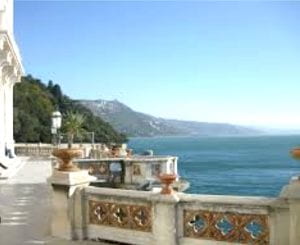
Trieste Coast and Miramare Castle

My dear wife spoke at the launch of MUTINY and said that she wondered whether the places we visited were because of the novel, or if the novel was written around them? In other words, did I design the travel first and use the locations for the novel, or did I plan the locations from the get-go, knowing they would feature in MUTINY?

The answer is a little complication—key locations were chosen, but secondary ones were woven into the plot. For example, Dubrovnik was ideal as a location, but we visited Trieste and it seemed a natural fit for one of the characters. In fact, I was hoping to use Trieste as a major plot element, but it didn’t quite fit. Perhaps, after all, Trieste might be better suited for another novel? It is a stunning city and an intriguing coastline. For the avid reader, may I recommend “Trieste and the Meaning of Nowhere” by Jan Morris – described as “a sublime meditation on a most unusual city.” It’s a beautifully crafted look at Trieste and the people who helped shape it. If only I could have utilised the Luxurious Miramare Castle – built from 1856 to 1860 for Austrian Archduke Ferdinand Maximilian and his wife, Charlotte of Belgium. Maximilian later became Emperor Maximilian I of Mexico – wherein is a tale with many twists and, alas, the demise of the puppet-hero. There were too many rooms to count in the castle and some we were not allowed entry to. However, my swim in the surrounding Adriatic was most relaxing. I’m sorry, Trieste, but maybe next time you will become an immortal location for one of my novels.