What a Wonderful World

I have just finished reading James Patterson’s autobiography – aka ‘The Stories of my Life’ – and feeling rather flat. Don’t get me wrong –  I have genuinely enjoyed this collection of lifetime reflections by James, but they ended on a low note for me. When my wife and I toured Europe back in 2019 (the birthplace for MUTINY) we discovered that the most popular song being played at restaurants was “What a Wonderful World.” First, a little history:

“…in the mid-1960s during the deepening national traumas, my co-writer George David Weiss and I had an idea to write a different song specifically for Louis Armstrong that would be called ‘What a Wonderful World. We wanted this immortal musician and performer to say, as only he could, the world really is great: full of the love and sharing people make possible for themselves and each other every day.” – Bob Thiele

Lois Armstrong

Armstrong’s first reaction to What a Wonderful World was “What is this?” But Armstrong began to warm to it, perhaps because he related it not so much to the social upheavals of the 1960s as to his own life. “There’s so much in What a Wonderful World’ that brings me back to my neighborhood where I live in Corona, New York,” Louis Armstrong said in 1968. Louis Armstrong managed to infuse the triteness of it all—the melody bears more than a passing resemblance to “Twinkle, Twinkle, Little Star”– with so much emotion as to have created one of his best-known songs. What is singular about his performance is that he stuck to the melody almost entirely throughout, something he rarely did. He occasionally plays with the rhythm, but for the most part he sings it as written—and beautifully, as What a Wonderful World lyrics seems to speak to his philosophy of life.”

I can remember listening to a keynote at NECC (the teachers’ conference). Over 10,000 were enthralled to hear a retired photographer from National Geographic talk celebrate ‘what’s right with the world’ in his beautiful images. I have never forgotten it and what a philosophy to live by. Let’s all celebrate what’s right with the world. After all, ‘What a Wonderful World’ we live in. And that’s the vibe I wanted to leave with my readers of MUTINY – a sense of hope and joy. I didn’t finish James Patterson’s biographical notes with that feeling, but wanted to. Sorry, James!

Rapid Fire Writing

The Old Man and the Sea

I get it. Short chapters speed up the action. Short sentences do too. I like the fact that the James Patterson I am reading has chapter lengths from one to three pages – short, punchy and page-turning stuff. Hemingway would be the same, right? Wrong. He writes economically, but takes his time to do so – like an author waiting for a suntan in the Spanish hills. I just skipped through a Hemingway chapter and it was – wait for it – over eleven pages long. Sleep inducing stuff and hardly fit for the modern age though it seems that The Old Man and the Sea is still a favorite in high school reading programs. And, funnily enough, The Old Man and the Sea pops up in MUTINY too. Why not? Both are about the sea and the men and women who brave it:

“A local out for a drink?”

“I think so. Did you see the walrus skin on the back of his neck?”

“Do you think he’s a fisherman?”

“I reckon so and I got a picture. Here, look.” The light cast deep shadows in the folds of his unshaven face.

“Wow, that’s a stunning photo – a perfect Hemingway moment.”

“I read a Hemingway book in school.”

“Which one? He wrote many.”

“It was about an old man and the sea.”

“And a big fish?”

“Yes, a poor fisherman in Cuba had caught nothing for eighty-four days.”

“It’s been about that long since I’ve had a boyfriend. How do you know this detail?”

“Because it included the same number of days as the title of another book I read, called Nineteen Eighty Four.”

In The Old Man and the Sea, the protagonist’s patience is rewarded with a huge catch which is reduced to a skeleton; in MUTINY, the protagonist loses a big catch and the promise of ending his career on a high note. In both books, something is lost in order to gain something far greater. What’s the catch? You will have to read it to discover it.

James Patterson the Raconteur

A raconteur is a person who tells anecdotes/stories in a skilful and amusing way. And, I must admit, that is what makes James Patterson’s autobiography stand out for me. His short chapters, full of anecdotes that tug at the soul, make for great reading. I like his life stories but still detest his thrillers and I have been pondering on that for some time and come to a conclusion – I prefer novels with a strong sense of place and I’m not a fan of violence. Perhaps that’s why I will never make a living by selling thrillers, though Patterson has. As he says, “…life is pretty good for a bestselling writer. I think I was born for this. And I still look at the world through the lens of a kid from Newburgh, New York. That helps me stay down-to-earth. Keeps things real, keeps me humble.” 
So, you now know – MUTINY is a tame thriller, but I hope it still tugs at your heart and surprises with its twists and turns. Above all, I hope it’s a novel you will want to read more than once, as I have had to do to get it to the place where I’m happy to give it away to my family and close friends (after all, you don’t want to see it returned to you next Christmas).

James Patterson and the Writing Bug

James Patterson writes, “…people ask me what they should do to become a writer. I usually tell them that if it’s meant to be, they won’t really have a choice. The writing just takes over everything. You think about writing all day, every day.”

I agree with James in many ways and my love of writing began at an early age when I wrote little books, complete with illustrations. I will see if I can find one and share it here. Then at age 12, I won a writing contest held by a local paper and the prize was a year’s worth of free movie tickets. I can’t think of a better prize for a young teenager. It was like being let lose in a candy store. At first, the theatre would only let me attend Saturday afternoon matinees but I soon had access to the ‘real’ movies, held in the evenings. I’m sure the exposure to the screen helped me see plots and drama, character development and many locations. Later, as a young teacher, I ploughed my creative juices into producing booklets for my students – handouts that went beyond the out-of-date textbooks. While doing this I noticed a large gap in resources for a Year 10 topic on Monsoon Asia, so I put together a booklet on this too – in fact, it led me to co-authoring a textbook which managed several reprints with the publisher, McMillan’s. So, writing has always been in my makeup, though I would disagree with James Patterson in that I don’t “think about writing all day, every day.” For me, it’s most days! And the topic for my prized writing at age 12? It was about my pet cat, Blackie.

Our Local Library and James Patterson

We took the grandkids to our local library today and spent quite some time browsing the shelves. I picked up “The Stories of my Life” by James Patterson – a collection of short, unrelated memories told in a lighthearted way. I was drawn by James’ candid chapters and think I will enjoy reading through them, even though I am not a fan of his thrillers.
Anyway, back to our local library. It’s a vibrant space in a small town and a sanctuary away from the frenetic shopping outside. The library’s architecture is unique above the main reading section – a series of concrete pillars with the wooden roof held in place by radiating native timber that use the pillars for an anchor. They reminded me of how many chapters work together to support a book. Back to James Patterson in my next post.

Another Reader Review

I have finished reading 3 WISE MEN. I have to say that, for me, the story was right up there with what David Baldacci and James Patterson write. I enjoyed the whole story and was somewhat disappointed when xxx was killed off and I guess for that matter the same with xxx…I look forward to Jak’s next adventure.” by Les Wills [reply: my next thriller does not feature Jak, but I have plans to use him again. ]

Tell it so they won’t want to leave

James Patterson is one of the world’s most successful authors, having sold roughly 450 million books – thrillers, non-fiction and romance novels. He was the best-selling author of adult fiction in the UK in 2020, according to Nielsen Book Research, and was recently announced as the most-borrowed author from British libraries for the 14th year in a row [source: BBC].

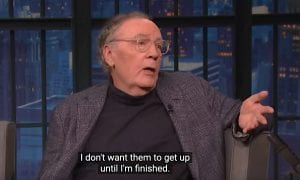
In a recent interview on Late Night with Seth Meyers, James Patterson says, “I always imagine someone’s sitting across from me. I’m telling them a story and I don’t want them to get up until I’m finished.” Great advice from the master and I hope each chapter I write keeps my imaginary reader in their seat.

How Important is the First Sentence?

Here’s a couple of openers from well-known thriller writers;

“Sam Harrison swung his agile body out of the silver blue Ford Aerostar, which he had parked ono Q Street in the Georgetown section of Washington.” [Jack and Jill by James Patterson]

“Duke Russell is not guilty of the unspeakable crimes for which he was convicted; nonetheless, he is scheduled to be executed for them in one hour and forty-four minutes.” [The Guardians by John Grisham]

Only two examples, but both start with the name of the main character/protagonist and both give a sense of place – Washington for Patterson and a prison(?) for Grisham. I prefer the urgency and mystery given in John Grisham’s opener, for two reasons; first, there are ‘unspeakable crimes’ which ups my interest; second, time is running out. A third reason could be that we owned a Ford wagon a while back and we were not that thrilled with it (LOL).

In my new novel I hope the opening line grabs the reader’s interest by suggesting tension, introducing a female character and creating a need to find out who is being followed and why. It reads;

“You are being followed,” she whispers.

I love this comment by Dawn Schaefer on the opening lines of Tinker, Tailor, Soldier, Spy by John le Carré; “There is the sense of having been dropped into the middle of a conversation, and a gossipy one at that...” And what, you will no doubt ask, are these lines?

“The truth is, if old Major Dover hadn’t dropped dead at Taunton races Jim would never have come to Thursgood’s at all.”

Now that we are on about Carré, here is my favorite opener (from Call for the Dead);

“When Lady Ann Sercomb married George Smiley towards the end of the war she described him to her astonished Mayfair friends as breathtakingly ordinary.”