Dark Clouds Gathering or a Downpour?

A Storm or Downpour

Formula-based thrillers start with a body and unwind to the culprit, often with more bodies thrown in. I general, I am against generalisations, but there needs to be some alarming event in the opening chapter of a thriller – dark clouds or, at least, a downpour. It’s more traumatic to be confronting a soaked victim (with a knife or bullet wound) at your front door than looking out the window and exclaiming, “Oh, it’s pouring outside.” As one writer advised, “Think of the high point of action and start your novel there.” That will get the reader’s attention. However, I prefer a mix – a gathering storm PLUS a dramatic event. When writing MUTINY I did not originally intend to have anyone murdered in the first chapter, but…(you will need to find out for yourself – free kindle offer finishes in three days). Meanwhile, stay indoors and enjoy the dark clouds gathering on the opening pages of MUTINY – they may well be followed by a downpour!

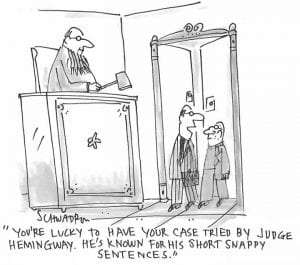
Is the Finish Line in Sight?

There is much debate about whether to write with a clear idea of the ending, or to wing it and let the writing unfold to a surprise conclusion. Before I started writing, I had no idea which process I would follow, but it soon became clear.

James Joyce

It is said that a friend once visited James Joyce as he wrote, inquiring upon arrival the source of the scribe’s obvious vexation. Of course it was the work, as always. “How many words did you get today?” queried the visitor. “Seven,” replied Joyce. “Seven? But James… that’s good, at least for you.” “Yes,” Joyce at last assented, before lamenting, “But I don’t know what order they go in!”

I think many writers can relate to the challenge of determining sequence and structure across an entire manuscript. So, who’s right? Is it better to set down your stakes straight away, finish line forever in sight, or at least in mind—or to wing it, to breathe life into your story and its inhabitants and sit back and enjoy the ride?

I must confess that I have no idea of how my novels will end, and that’s why I love writing. I wait for the ending to surprise me, then hope that my readers react in the same way. My first ending for MUTINY was OK but – as one of my Beta Readers pointed out – there was no real twist. I went back to editing the manuscript and ‘discovered’ an ending that was far better. And it got even better after meditating on it for a few days. Looking back on my writing journey for MUTINY, I spend countless hours on the opening chapter – feeling much like James Joyce struggling over every word – and an equal number of hours agonising over the finishing lines. The hours soon became days and the days years, until MUTINY was well-matured and ready to print. And, the funny thing is, James Joyce happens to make an appearance in MUTINY.

My best first critic!

I was pleased with myself. Chapter One for my new novel read perfectly; at least I thought so. But I needed an independent critic – someone I trusted to be honest, even brutally honest, and give constructive feedback. Aha! I had the perfect person – my wife! She endured endless revisions of my first thriller and was keen to read my second. I was anticipating a great response to Chapter One. “Did you like it?” I asked. The reply was not what I expected.
“Well,” she replied, “I just could not get into it.”
Shock, horror. “Why not?”
“I dunno. It was just too technical. But, I was tired when I read it, so I will try again.”
There it is! She was tired. I am let off the hook; the chapter is good after all? I waited for her second take.
“No, it just doesn’t gel for me.”
“Damn!” What did I do wrong? I spend hours on this opener and now it has fallen flat. I need to really think hard about this; not rush it; give it another angle.

Hours later – days actually, and I had an idea; an approach that was based on human interaction and left out most of the technical details. “Here is a new Chapter One.”
“O.K.,” she said, “I’ll read it later.”

“What did you think?”
“Much better, and it drew my interest. It also reminded me of an event at one of your schools.”
I was relieved, but learned an important lesson, and thanked my best critic – my wife!